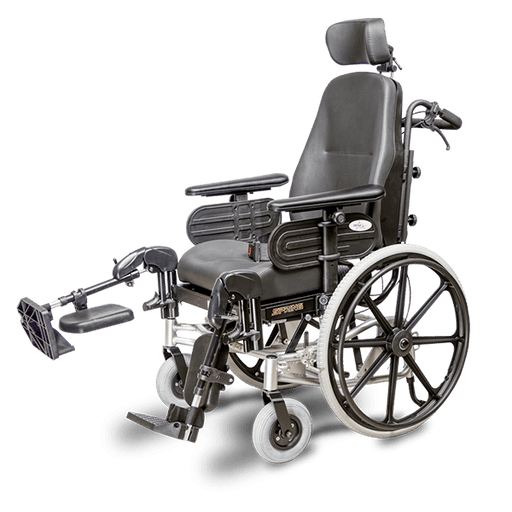
Discover the Comfort of Reclining Wheelchairs
A reclining wheelchair is more than a comfort upgrade. It is often a clinical necessity for users who cannot safely or comfortably sit upright for extended periods, and understanding why that matters is the first step to choosing the right chair.
The Benefits of a Reclining Back Wheelchair
Reclining wheelchairs are commonly prescribed for users who cannot maintain an upright seated position for extended periods, including those managing spinal cord injuries, multiple sclerosis, orthostatic hypotension, or post-surgical recovery.
Changing the backrest angle reduces sustained pressure on the ischial tuberosities, a primary risk site for pressure injuries, also called pressure ulcers or decubitus ulcers. For anyone spending long hours in a wheelchair, that positional flexibility is a meaningful clinical benefit.
Unlike a standard rigid or folding wheelchair, a reclining model features a backrest that pivots independently from the seat, typically adjusting from 90 degrees upright to 170 to 180 degrees near flat. This makes reclining wheelchairs well suited for users:
- With limited trunk control
- With elevated risk of pressure injury
- Who require catheter care or tube feeding in a reclined position
- Who fatigue quickly in an upright posture.
Wheelchair That Reclines: Features and Options
Our recliner wheelchairs come with a range of features designed to enhance your experience. From manual reclining wheelchairs that are easy to adjust to models that combine recline and tilt functions, we have options to suit your specific needs. Reclining and tilting wheelchairs provide additional positioning options for users who need extra support and sustained pressure relief throughout the day.
Shop Our Reclining Wheelchairs
With the clinical basics covered, it helps to look at how these chairs are built and operated day-to-day, starting with the manual reclining mechanism most models rely on.
Manual Reclining Wheelchair
Our manual reclining wheelchair selection offers ease of use and genuine independence. Most models use a lever or push pin system on the rear upright posts. The caregiver releases the lock, guides the backrest to the desired angle (commonly adjustable in 10- to 15-degree increments), and re-engages the lock.
Because reclining the backrest shifts the user’s center of gravity rearward, quality models include anti-tip casters as a standard safety feature. Confirm that any chair you consider includes them or offers them as an add-on.
Recliner Wheelchairs for Enhanced Mobility
Each recliner wheelchair in our collection is engineered for smooth maneuverability and stability. Frames are constructed from steel, which is heavier and more affordable, or aluminum alloy, which is lighter and easier to transport. Many manual reclining models also use a folding cross brace frame, so if portability between recline sessions matters to you, check out our folding wheelchair.
For adult users, weight capacity commonly ranges from 100 kg to 160 kg (about 220 to 350 lbs), depending on the model, and seat width ranges from 16 to 22 inches. Selecting the correct width, roughly 1 inch wider than the user’s widest hip measurement, helps prevent pressure on the greater trochanters during extended sitting. Pediatric reclining models are built to a different scale entirely. The Ziggo Pro, for example, is rated for 150 lbs on the 12-inch seat width and 200 lbs on the 14-inch seat width, well below adult capacities, since it is sized for children rather than adults.
Positioning Options: Recline Range and Terrain
Beyond the mechanics, the right chair also depends on how much recline you need and where you’ll use it, from everyday indoor use to specialized outdoor and beach settings.
Wheelchairs That Recline
Our range includes various wheelchair models that recline to accommodate different body types and preferences, including leg elevation. Elevating leg rests are a critical companion feature to recline. When the backrest reclines, the hamstrings tighten unless the leg rests also elevate, which can cause the user to slide forward in the seat through a phenomenon called shear. Look for models where leg-rest elevation is mechanically linked to the backrest recline angle for the most comfortable and safe positioning.
A full recline or near flat-lying position typically means 170 to 180 degrees from vertical, which describes models like the Ziggo Pro, rated for a 90 to 180 degree recline range. A semi-recline or partial recline usually refers to 120 to 150 degrees, which is sufficient for pressure relief without requiring the user to be fully supine. Whether you need occasional postural relief or full rest positioning, there is a model in our range to match.
Reclining Manual Wheelchair
Our reclining manual wheelchair models combine the independence of a manual chair with the comfort of a reclining back. These chairs are a strong choice for users who want the control and familiarity of a traditional wheelchair, plus the postural flexibility reclining provides.
Beach Reclining Wheelchairs
We offer a select range of reclining wheelchairs designed for the beach, for those who refuse to let mobility challenges keep them from enjoying the waterfront. Beach reclining wheelchairs feature oversized balloon tires, also called fat tires or all-terrain tires, that distribute weight across soft sand without sinking. The combination of a reclining backrest and wide tread tires makes these chairs well suited for sand, gravel, and uneven outdoor terrain.
Reclining Wheelchairs: Combining Comfort and Functionality
Comfort features go beyond recline angle alone. Backrest style and armrest configuration play just as large a role in how supported and adjustable a chair feels day to day.
Reclinable Wheelchair
A reclinable wheelchair is an ideal solution for those seeking a balance between flexibility and support. By adjusting the high backrest, users can find a comfortable position that suits their needs throughout the day. When the backrest reclines beyond approximately 30 degrees from upright, a headrest or head support becomes necessary to prevent the user’s head from falling back unsupported. Confirm the model includes an adjustable headrest or that one is available as an accessory.
Also consider the armrest style. Desk length, cutaway, and armrests are preferable for users who need to transfer in and out of the chair, while full-length armrests provide more lateral support during recline.
Wheelchair with Adjustable Back
For users who need a customizable seating angle, wheelchairs with adjustable backs offer a practical, often more compact solution. An adjustable back wheelchair offers a narrower range of recline, for example, 90 to 120 degrees, compared to a full recliner. This makes it a lighter option for users who need occasional postural relief rather than full rest positioning, and it is often easier to transport and store.
Advanced Features in Reclining Wheelchairs
For users with more complex positioning needs, some chairs go beyond recline by adding a second, independent function called tilt.
Wheelchairs That Recline and Tilt
Our advanced models of wheelchairs that recline and tilt provide the ultimate in positioning and comfort, but it helps to understand how the two functions differ. In a tilt-in-space system, the entire seat and back unit rotates as one unit around a fixed hip point, maintaining the hip angle while shifting the user’s weight off the ischial tuberosities. In a recline system, only the backrest moves, changing the hip angle and potentially introducing shear at the seat-back junction.
The EV Rider Spring illustrates the tilt-in-space approach well. Its Tilt N Space seat tilts up to 30 degrees rather than reclining the backrest independently, a smaller range of motion than a full recline chair but one that avoids the shear forces that come with reclining alone. Many advanced models combine both functions to deliver pressure redistribution without the drawbacks of recline alone.
Occupational therapists and physiotherapists generally recommend tilt in space for users with high pressure injury risk or poor trunk control because it redistributes pressure without the shear forces associated with recline alone.
Lay Down Wheelchair
A lay-down or near-flat reclining wheelchair is often used for users who require periodic supine positioning due to conditions such as dysautonomia, postural orthostatic tachycardia syndrome, or severe spasticity. The backrest on these models typically reaches 170 to 180 degrees, and the leg rests elevate simultaneously to a near-horizontal plane, providing a fully supported rest position. One practical note: most reclining wheelchairs are not approved as motor vehicle seats in their reclined position. Transport users upright, at 90 degrees, with appropriate tie-down systems in place.
How to Choose a Reclining Wheelchair: Key Buying Considerations
Choosing the right reclining wheelchair depends on five core factors: the user’s clinical needs, body measurements, environment of use, caregiver involvement, and budget. Here is how to evaluate each.
-
Clinical needs: Start with the reason recline is required. Users with high pressure injury risk, poor trunk control, or conditions such as spasticity or dysautonomia may benefit from a model that combines tilt-in-space with recline. An occupational therapist assessment is the most reliable way to identify the right recline range for complex needs.
-
Body measurements: Seat width should be approximately 1 inch wider than the user’s widest hip measurement to avoid pressure on the greater trochanters. Seat depth should allow a two- to three-finger gap between the front edge of the seat and the back of the knee.
-
Environment of use: A chair used primarily indoors on smooth floors has different requirements than one used outdoors or on varied terrain. For outdoor and beach use, look for wider tires and a robust frame.
-
Caregiver involvement: If a caregiver will operate the recline mechanism, a lever or push-pin system on the rear uprights is straightforward to use. If the user will self-propel, confirm the chair’s overall weight and folded dimensions are manageable for transport.
-
Weight capacity and frame material: Adult models commonly support between 220 and 350 lbs, while pediatric models are rated significantly lower to match their smaller frames. Steel frames are more affordable but heavier, and aluminum alloy frames are lighter and easier to lift into a vehicle.
-
Funding and insurance: In the United States, reclining wheelchairs may be covered through Medicaid waiver programs or other funding pathways depending on the user’s clinical documentation. Contact our team if you have questions about what to ask your provider.
Also confirm whether elevating leg rests and anti-tip casters are included standard or available as an add-on. Both are important safety and comfort features for most reclining wheelchair users, and they are easy to overlook when comparing models on price alone.
Find Your Ideal Recliner Wheelchair Today
Browse our selection of reclining wheelchairs and find the right match for your mobility and comfort needs. If you have questions about any model or want guidance on which features suit your situation, our team is just a phone call away. We offer free shipping, no sales tax in most states, and lifetime phone support on every purchase.