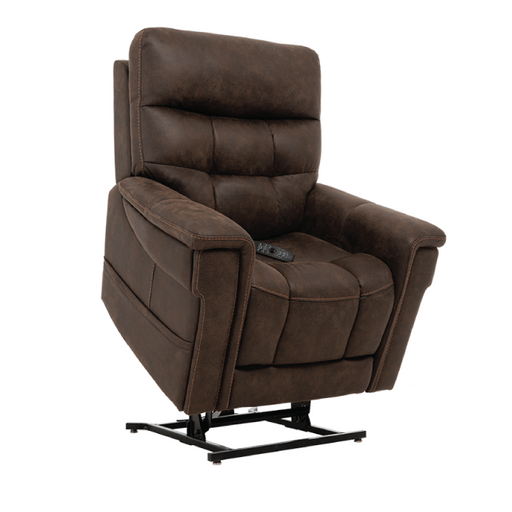
Understanding Lift Chairs for the Elderly
Getting up from a seated position sounds simple until it isn't. For many older adults, that moment of transition from chair to standing represents a genuine daily challenge, one that can lead to falls, joint strain, or a quiet erosion of independence. Lift chairs exist to address exactly that problem, not as a luxury item, but as practical assistive furniture that makes a real difference in day-to-day safety and comfort.
Lift chairs use a motorized mechanism built into the base and seat to assist elderly individuals with standing and sitting. When activated, the frame tilts the entire seating surface forward and upward, guiding the user toward a standing position without requiring them to push off armrests or strain their lower back and knees. The reverse motion lowers them gently back down. For someone managing arthritis, recovering from joint replacement surgery, or dealing with reduced leg strength, this single function can change the texture of an entire day.
These chairs also serve a second role as recliners, offering various positions for comfort and rest. Models range from basic two-position designs that tilt slightly back with the footrest raised, to fully articulating configurations that recline at any angle. Some models from brands like Vocic carry a sofa-style profile, making them visually compatible with living room furniture while delivering full assistive functionality. In most configurations, the footrest is integrated into the chair and extends as the backrest reclines, providing leg elevation that supports circulation and reduces swelling.
How Lift Chair Positions Work
The position system is one of the most important variables when choosing among chairs elderly users will actually rely on. Manufacturers typically classify lift chairs into three broad categories.
Two-position models are the most basic option. They move between an upright seated position and a slightly reclined angle with the footrest raised. They do not recline far enough for sleeping or extended rest, but they cover the core mobility assistance function at a lower price point.
Three-position chairs go further, reclining to a nearly flat position similar to a traditional recliner. This makes them suitable for napping or extended rest. The lift mechanism operates independently of the reclining function, so users can raise themselves to standing from any supported position.
Infinite position and zero gravity models represent the most advanced tier. According to US Medical Supplies, these chairs allow the user to "recline from the upright position to any angle, even completely flat," with independent control over the backrest and footrest. This level of adjustability matters most for users who spend extended time in the chair due to health reasons or limited mobility outside the home.
Zero gravity positioning, a subset of infinite position designs, places the legs slightly above heart level while the back reclines. This orientation reduces spinal compression and eases pressure on the heart, making it a common recommendation for users with circulation concerns or chronic back pain.
Price Ranges and What to Expect
The relationship between price and capability is fairly consistent across the category.
|
Tier
|
Price Range
|
What You Get
|
|
Entry-level (two-position)
|
Under $900
|
Core lift assistance, basic recline
|
|
Mid-range (three-position)
|
$900 to $1,800
|
Near-flat recline, covers most buyer needs
|
|
Infinite position / specialty
|
Above $1,800
|
Full recline, independent backrest and footrest control, premium upholstery, bariatric options
|
Fabric choice, weight rating, and add-on features like built-in USB charging ports, side pockets, and heat and massage functions all affect where a given chair lands within these brackets. At the higher end, premium pricing often reflects upholstery quality, extended weight capacity for bariatric use, or wall-hugger engineering that lets the chair recline without requiring significant clearance behind it.
Who Benefits Most from a Lift Chair
The clearest candidates are adults with conditions that compromise lower-body strength or joint flexibility, including hip and knee osteoarthritis, post-surgical recovery, Parkinson's disease, multiple sclerosis, and age-related muscle weakness. Lift chairs also serve a preventive role, for older adults who are still mobile but at elevated fall risk, the chair replaces one of the most common moments when falls occur, the unsteady push upward from a deep sofa or low seat.
Caregivers frequently identify the lift chair as one of the first purchases that meaningfully reduces their own physical workload, since they no longer need to manually assist a family member with every seated-to-standing transition throughout the day.
Medicare and Financial Assistance for Lift Chairs
The sticker price on a quality power lift chair can give anyone pause. For seniors on a fixed income, that number can feel like a hard stop. Paying full retail out of pocket, however, is rarely the only path forward. Between Medicare coverage, flexible spending accounts, and nonprofit assistance programs, there are several legitimate ways to reduce what you actually spend.
What Medicare Will and Won't Cover
Medicare may cover part of the cost of a lift chair if it is deemed medically necessary. Specifically, Medicare Part B may pay for the lifting mechanism of a power lift chair when a doctor prescribes it as durable medical equipment (DME) for a patient with a qualifying condition such as severe arthritis, muscular dystrophy, or another disorder that makes independent standing unsafe or impossible.
The key distinction is that Medicare covers the motorized lift mechanism itself, not the chair as a piece of furniture. In practical terms, Medicare reimburses a set amount toward the mechanical component based on the Medicare fee schedule, and you are responsible for the remaining chair cost along with any standard Part B deductible and coinsurance. The chair's retail price does not change how much Medicare pays.
To qualify, you will need a written prescription or certificate of medical necessity from your treating physician, and you must purchase from a Medicare-enrolled DME supplier. Skipping either step typically results in a denied claim. If you are enrolled in a Medicare Advantage plan, check your plan's specific DME benefit, since some plans offer broader coverage or lower cost-sharing than Original Medicare.
Using an FSA or HSA to Offset Costs
If Medicare does not cover your situation or leaves a meaningful balance, a flexible spending account (FSA) or health savings account (HSA) can close part of that gap. Both accounts allow you to use pre-tax dollars for qualifying medical expenses, and a power lift chair prescribed by a physician generally meets that standard.
The math is straightforward. In a 22 percent federal tax bracket, using FSA funds to pay for a portion of a lift chair is effectively a 22 percent discount compared to paying with after-tax income. On a $1,200 chair, that translates to roughly $264 in real savings. It is not a subsidy program, but it is money that would otherwise go to taxes.
Check with your FSA or HSA administrator before purchasing to confirm the chair qualifies under your specific plan. A letter of medical necessity from your doctor strengthens the case if any question arises during reimbursement.
Nonprofit and State Assistance Programs
Several national and regional nonprofits provide assistive equipment to low-income seniors, including refurbished or donated lift chairs. Area Agencies on Aging, which operate in every state, often maintain lists of local resources and can connect you with programs specific to your county or region. Medicaid, for those who qualify based on income, may cover lift chairs under home and community-based waiver programs, though coverage rules vary significantly by state.
Some manufacturers and retailers also offer financing plans with low or zero interest for qualified buyers, which at minimum allows you to spread cost over time without adding to it.
Matching Chair Features to Your Budget
Lift chairs are not a single product tier, and that range matters when you are working with partial coverage. Three-position lift chair recliners start around $933 and allow the user to recline from upright to a nearly flat napping position, or anywhere in between. More advanced models with additional recline positions, heat, massage, or extended weight capacity carry higher price points.
If Medicare is contributing toward the lift mechanism, it may make sense to choose a model that maximizes comfort features within the remaining budget rather than defaulting to the least expensive option. Multiple reclining positions allow the user to shift posture throughout the day, which reduces pressure buildup and supports circulation during long periods of seated rest.
Thinking about the chair as a long-term medical investment rather than a furniture purchase often changes the calculus. A well-chosen power lift chair used daily for several years amortizes to a modest daily cost, particularly when assistance programs reduce the upfront amount.
Comparing Lift Chairs and Traditional Recliners
If you already own a recliner you love, replacing it can feel unnecessary. But when mobility starts to change, the question shifts from comfort to function, and that is where a standard recliner and a power lift chair begin to diverge in ways that genuinely matter.
The core difference comes down to what happens at the moment of standing. A traditional recliner returns you to an upright seated position and stops there. Getting to your feet is still entirely up to you. For someone managing post-surgical recovery or lower limb weakness, that last push from seated to standing is often the hardest and riskiest part of the day. Lift chairs close that gap by continuing the motion, gently tilting the seat forward and raising the platform until the user is nearly upright, reducing the muscular effort and balance demands that cause falls.
What Traditional Recliners Do Well
A conventional recliner delivers comfort across a wide range of body types and budgets. The reclining mechanism is typically manual or lightly motorized, and the footrest extension is sufficient for casual relaxation. For users without significant mobility challenges, a quality recliner handles everyday sitting needs without complication.
The trade-off is limited therapeutic positioning. Most traditional recliners stop at a partial or flat recline with no ability to fine-tune the angle based on medical need. For someone managing spinal curvature or pressure sore risk, that fixed range becomes a genuine limitation. There is also the cumulative toll of daily transitions, a recliner that requires full lower-body engagement every time a person wants to stand adds fatigue and fall risk to each of those moments.
Where Lift Chairs Pull Ahead
The powered lift mechanism is the obvious differentiator, but higher-end models extend the advantage further through positioning capability. Certain lift chair recliners offer infinite position control, meaning the user can recline from upright to any intermediate angle, including fully flat, with independent backrest and footrest adjustment. Models in this category start around $1,365 and give caregivers and users precise control over head, back, and leg elevation. This matters considerably for conditions like scoliosis, where a single standardized recline angle may create spinal pressure rather than relieve it.
Zero gravity positioning, available at this tier, distributes body weight so that no single point bears disproportionate load. For users with chronic back conditions or circulation concerns, that orientation reduces discomfort during extended sitting in a way a traditional recliner cannot replicate.
Practical Accessories That Extend Functionality
One underappreciated factor in the lift chair versus recliner comparison involves the surrounding environment. Users who need lift assistance often benefit from complementary aids, such as suction cups mounted beneath furniture legs to prevent chair drift on smooth floors. When a powered seat applies forward momentum during the lift cycle, a chair that shifts position undermines both safety and function. Small details like this affect real-world performance in ways a showroom visit won't reveal.
Which Option Fits Which Situation
For a generally healthy adult looking for a comfortable place to unwind, a standard recliner is a practical and cost-effective choice. The lift chair category is designed for a different user profile, someone for whom standing assistance is a daily need, not an occasional convenience.
If scoliosis, joint replacement recovery, Parkinson's disease, or general deconditioning is part of the picture, the positioning range and powered lift mechanism of a lift chair address real functional gaps. Choosing between two-position, three-position, and infinite-position models should reflect how much postural control the user actually needs.
A traditional recliner asks the user to meet the chair on its terms. A well-chosen lift chair recliner is built to meet the user where their body actually is.
Choosing the Right Lift Chair, Key Considerations
You have decided a lift chair makes sense. Now comes the part that trips up most shoppers, figuring out which one actually fits the person who will use it every day. Size, weight rating, fabric, and optional features all interact in ways that are not obvious until you are sitting in the wrong chair at home with no easy return label in sight.
Getting the Size Right
A chair sized for a 5'4" frame positions the footrest, seat depth, and headrest very differently than one built for someone 6'1". When the seat is too deep, a shorter user slides forward to find the floor and loses lumbar support entirely. When the seat is too shallow, a taller user feels perched rather than supported.
Most manufacturers categorize lift recliners into small, medium, large, and tall or petite models. As a general rule, measure the user's seated height from the floor to the back of the knee and compare that to the chair's seat height specification. Seat depth should allow the user to sit fully back with two to three inches of clearance between the seat edge and the back of the knee.
Weight capacity is an equally important figure. Standard models typically support up to 300 to 350 pounds, while heavy-duty and bariatric options extend that range to 500 pounds or more. Choosing a chair rated well above the user's actual weight is not just about safety. A motor working near its rated limit wears out faster than one operating comfortably within its range, and that affects long-term reliability.
Matching Features to Daily Life
Once size is sorted, features become the meaningful differentiators.
- Two-position chairs recline partially, similar to a standard recliner but not flat.
- Three-position chairs reach a nearly horizontal angle suitable for extended rest.
- Infinite position or zero gravity models allow the back and footrest to move independently, letting the user find a custom angle for reading, watching television, or sleeping. If the person plans to nap in the chair regularly, this tier is worth the added cost.
Heat and massage functions are not just comfort extras. For people dealing with chronic back pain, arthritis, or poor circulation, gentle lumbar heat loosens stiff muscles and a low-intensity massage setting can improve blood flow during long sitting periods. USB charging ports have become common and are genuinely useful for keeping a phone or tablet within reach. Side pockets or storage pouches are a practical place for a remote, a book, or a phone when reaching far is not easy.
Accessories like a coordinating ottoman or a lumbar throw pillow are worth considering even if they are not built into the chair. An ottoman at the right height supports the legs when the footrest is in its standard position. A lumbar or neck pillow fills gaps between the user's back and the chair if the fit is not perfect, which is common when ordering online without a showroom try-on.
Fabric and Placement
Fabric choice affects both durability and ease of care. Leather and bonded leather wipe clean easily, which matters for users who eat or drink in the chair or who have skin sensitivity. Microfiber and polyester blends tend to be softer and less prone to temperature extremes, since they do not feel cold in winter the way leather can.
Placement inside the home is a practical constraint that narrows options quickly. Wall-hugger models need only a few inches of clearance behind the chair to recline fully, making them the default choice for smaller rooms. Standard recline models require significantly more floor space. Measure available wall clearance before selecting a model.
If you are shopping during a promotional period, it is worth checking whether discount codes apply to the specific brand or model you want. Retailers like Restore Mobility run seasonal promotions that can reduce the total cost meaningfully, though terms vary by brand and model.
Thinking Through the Full Decision
Start with fit, meaning size and weight capacity. Then add the features that address the user's specific daily habits and health needs. Then match the fabric and footprint to the room where the chair will live. Skipping that order and shopping by price or aesthetics first usually leads to a chair that looks right but does not work right over time.
A well-matched lift chair gets used. A poorly matched one sits unused, which defeats the entire purpose.