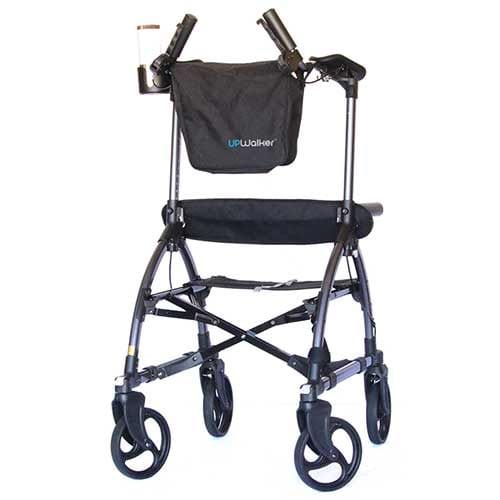
The UpWalker, Revolutionizing Walking Aids
UpWalker Upright Walker, Your Partner in Mobility
The UpWalker Upright Walker is engineered to support you in a fully upright position, which can help reduce back pain, improve posture, and restore a more natural stride. While a standard walker reinforces a forward lean, the UpWalker’s padded forearm cradles, with an adjustable angle, hold your arms at the right height so your head stays up and your shoulders stay back.
The UpWalker Standard accommodates users approximately 4’10” to 6'4” tall, with forearm supports that adjust to match your arm length precisely. The weight capacity reaches up to 300 lbs, and the frame folds compactly for car trunk storage, so you don’t leave it behind when you travel.
UpWalker Walker, A Synonym for Stability
Stability on an upright walker comes from specific structural choices, not just a sturdy-looking frame. The UpWalker Walker features an aircraft-grade aluminum frame that keeps the product light enough to lift into a vehicle without strain, while front wheels measuring about 8 inches in diameter roll smoothly over sidewalk cracks, thresholds, and uneven outdoor terrain that smaller 6-inch wheels on standard rollators struggle with.
Loop brakes handle braking: squeeze the lever to slow your pace, then push down to engage the parking brake when you stop. The built-in seat gives you a place to rest when you need it, making this a practical choice for anyone managing limited endurance alongside limited mobility.
Benefits of Walking Upright: Why Posture Matters
Standard walkers and rollators require you to hunch forward, which compresses the lumbar spine, strains the wrists, and can accelerate the postural decline that made a walking aid necessary in the first place. Over time, that forward lean contributes to forward-head posture, shoulder pain, and reduced core engagement, which makes walking feel harder, not easier.
An upright walker addresses this directly. By positioning your forearms at a higher, angled platform, the design reduces compressive load on the lumbar vertebrae. It discourages the kyphosis (rounded upper back) that standard walkers tend to reinforce. Physical therapists and occupational therapists often recommend upright walkers for users with spinal stenosis, kyphosis, Parkinson’s disease, and arthritis because maintaining an erect posture reduces secondary strain on joints and muscles already under stress.
The practical benefits you notice day-to-day include less lower-back fatigue after longer walks, reduced wrist and shoulder pain, and a more confident gait because you can see where you are going rather than watching the ground. For many users, switching to a stand-up walker with a seat is the single change that makes walking feel sustainable again.
Up Walkers, A Diverse Range for Your Needs
If you need more than a cane but want to avoid the stooped posture of a traditional walker or rollator, an upright walker with a seat is the clinically preferred middle ground. Our collection covers several distinct models so you can match the right frame to your height, weight, lifestyle, and travel habits.
|
Model
|
Key Feature
|
Best For
|
|
UpWalker Standard
|
Forearm cradles, up to 300 lb capacity, fits 4’10” - 6'4”
|
Everyday home and community use
|
|
UpWalker Lite
|
Lightweight frame (~18 lbs), compact fold
|
Travel, apartment living, lighter users
|
|
UpWalker Rollator
|
4-wheel rollator with upright forearm platform
|
Users transitioning from a standard rollator
|
Each model shares the core upright posture design. The differences come down to weight, folded dimensions, and the specific support platform, so the right choice depends on how and where you plan to use it most.
UpWalker Rollator: The Ultimate Walking Solution
The UpWalker Rollator takes the familiar 4-wheel rollator format. It raises the support platform to forearm height, so your spine stays erect rather than tipping forward as it does on a conventional rollator. That single change in geometry makes a significant difference in comfort over longer distances.
The seat sits approximately 21 to 23 inches from the ground, with a weight rating that supports most users comfortably. A storage pouch or basket is included for carrying personal items, and the one-hand fold mechanism brings the frame to a compact width that fits in most car trunks without rearranging cargo. Loop brakes and a parking brake are standard, giving you reliable control on slopes and uneven surfaces.
UpWalker Upright Mobility Walker: Enhance Your Independence
The UpWalker Upright Mobility Walker is designed for those who want to maintain an active daily life without compromising on support. Its ergonomic design encourages a natural walking position, and the seat provides a quick, easy way to take a break whenever you need one. Whether you are moving through your home, running errands, or spending time outdoors, this walker is built to keep up with your routine.
Choosing the Right Stand Up Walker with Seat
Finding the right fit takes a few minutes of honest self-assessment. Here is what to consider before you decide.
-
Your height: Confirm the forearm platform adjusts to your arm length. Most upright walkers fit users from 4’10” to 6’4”, but verify the specific model’s range.
-
Weight capacity: Standard models support up to 300 lbs. Check the spec before purchasing if you are near that limit.
-
Indoor vs. outdoor use: Larger wheels (8” or more) handle cracks, curbs, and uneven pavement. Smaller wheels are more maneuverable in tight hallways and smaller rooms.
-
Portability: If you travel or use public transit regularly, check the folded dimensions and total product weight. Aim for under 20 lbs if you need to lift the walker into a vehicle frequently.
-
Seat comfort: Look for a padded seat with a minimum 15-inch width for comfortable resting.
Browse our full collection of upright walkers to compare models side by side, or call us at 800-971-5369 any time of day or night, and we will help you find the right fit.